

Finding a play therapist north of the city is harder than it should be. What the options are, what to ask before you book, and how the funding works.
A school wellbeing officer suggests play therapy. You search it, and every promising result sits in Fitzroy, Camberwell or Geelong. Forty minutes each way, on a Tuesday, with a seven-year-old in the back.
That is the real problem for families in Hume, Whittlesea and Mitchell Shire. Not whether play therapy works. Whether you can reach it.
Play Therapy or Play Interventions?
Same work, two names.
Play therapy, which we deliver as play interventions, uses toys, sand, art and imaginative play to help a child work through feelings they cannot yet put into words. A trained practitioner follows the child’s lead and works at the child’s pace rather than asking direct questions.
We use “play interventions” because it describes the work more accurately than “therapy” does. Most parents search for play therapy, so both words appear here on purpose. Our full explainer covers what actually happens in a session, start to finish.
The approach has decent evidence behind it. A 2021 overview in the journal Materia Socio-Medica found play-based therapeutic work suits preschool and school-age children dealing with transitions such as divorce or loss, with managing emotions and behaviour, and with the effects of domestic violence, abuse and bullying.
Which Approach Suits Which Child?
Parents land on three similar-sounding options and cannot tell them apart. Here is the difference.
| Play interventions | Sand play interventions | Child and family counselling | |
|---|---|---|---|
| How it works | Play-led sessions, practitioner follows the child | A sand tray and small figures, used to work through experiences symbolically | Talk-based, often with activities alongside |
| Who it suits | From around three years, and it keeps working well past eleven | Used inside play interventions, same age range | Children who can already talk through what is bothering them, usually with family sessions alongside |
| Best for | Trauma, grief, anxiety, sudden behaviour change | Processing a specific event without having to face it head on | A defined issue a child can name |
| Read more | The parent’s guide | Sand play explained | Child and family counselling |
None of these is automatically the better choice. A child who has just lost a grandparent might do best with open play. An older child who can put words to the worry might be ready for counselling. Work it out in the first conversation rather than guessing from a website.
Not sure whether to act at all? Signs your child may benefit from counselling sets out what usually prompts a family to call.
Why Location Changes the Outcome
Travel time is the obvious cost. A child who has spent forty minutes in traffic walks into the playroom already depleted, and you lose part of a session you are paying for.
The less obvious cost is local knowledge. A practitioner working regularly across Craigieburn, Epping, Wallan and Seymour knows the school wellbeing teams, the GPs and the NDIS Local Area Coordinators by name. Referrals move faster. Follow-up actually happens. Our Melbourne North service area page lists every suburb we cover, and we work north into the Goulburn Region with the same team.
What to Ask Before You Book
Five questions that separate a good fit from a long drive:
- Do you see families in my suburb regularly, or would mine be the occasional trip?
- Where do sessions happen? A room, our home, my child’s school?
- What is the wait to a first appointment, realistically?
- Can you work with my child’s NDIS plan, and which plan management types do you accept?
- How will you tell me it is working, and how often will we review it?
Any service should answer all five without hedging.
How Is Play Therapy Funded?
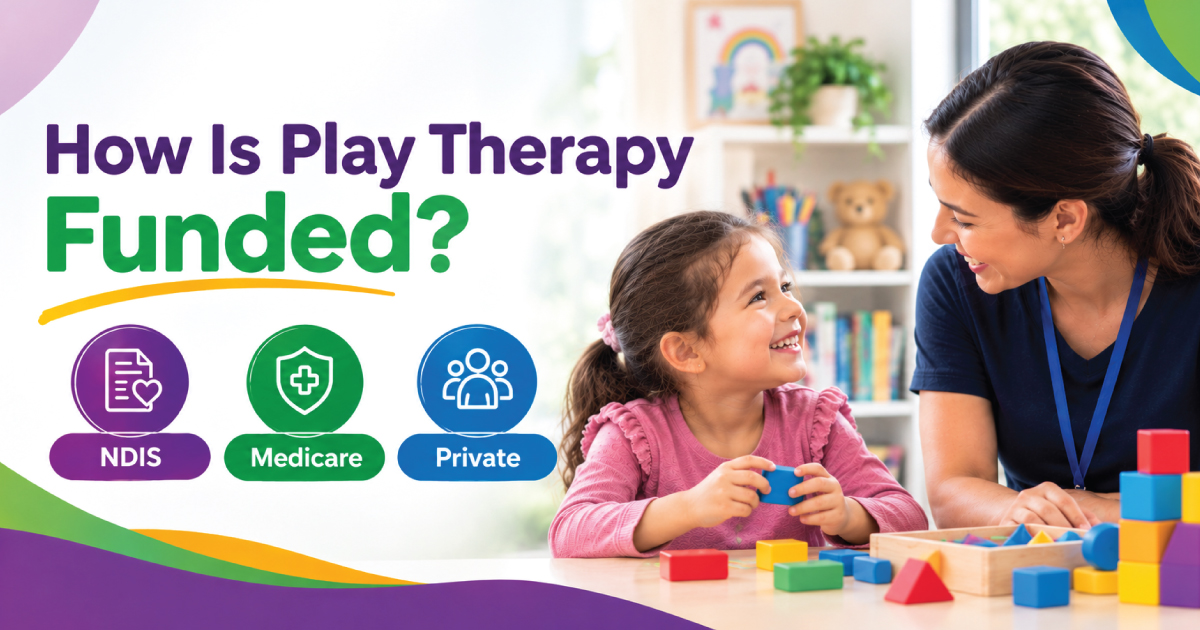
Three routes, and they are not equally open to everyone.
NDIS. Play interventions are funded as a therapeutic support from the Capacity Building part of a plan, usually under Improved Daily Living. The NDIS is clear that Capacity Building funding is a stated support, so you cannot move money between support categories once the plan is written. Raise play interventions at your planning meeting rather than after it. Our support coordination team can work through it with you.
How your plan is managed also decides who you may see. We are not a registered NDIS provider. We work with self-managed and plan-managed participants. Participants on NDIA-managed plans need a registered provider for those supports, and we will tell you so rather than let you find out later.
Medicare. A Mental Health Treatment Plan from your GP gives access to rebated sessions, but the rebate runs to registered psychologists, mental health social workers and some occupational therapists. Counselling and play interventions generally do not attract it. Ask any service directly. Ours do not.
Private. Straight fee for service, no referral, no diagnosis, no waiting for a plan.
If you or a child is in immediate danger, call 000. For 24/7 support contact Lifeline on 13 11 14, Kids Helpline on 1800 55 1800, 1800RESPECT on 1800 737 732, or Safe Steps on 1800 015 188. Our counselling service is not a crisis or after-hours service.
Getting Started
We are a mobile service, not a clinic. Sessions happen in agreed therapeutic spaces, at home, at school or in community venues across Melbourne North and the Goulburn Region.
Start with a referral, or just get in touch. The first conversation is with you rather than your child, and we will say honestly whether play interventions, sand play or child and family counselling is the right starting point. Sometimes the answer is that you need someone else, and we will say that too.
FAQ
Is play therapy the same as play interventions?
Yes. Play interventions is the term we use for the work most parents search for as play therapy. Same approach: a trained practitioner using toys, sand, art and imaginative play to help a child process something they cannot yet put into words.
What age is play therapy suitable for?
Generally from around three years. Below that, the more useful work is usually with the parent, focusing on the relationship and the home environment. Play-based approaches keep working well past eleven, with the materials changing as children get older.
Can the NDIS pay for play therapy?
Often, yes. Funding comes from Capacity Building, usually Improved Daily Living, and has to link to a goal in the plan. Capacity Building is a stated support, so funding cannot be shifted between categories once the plan is set.
How do I find play therapy in Craigieburn, Wallan or Seymour?
We cover Craigieburn, Epping, Wallan, Seymour and the surrounding suburbs across Hume, Whittlesea and Mitchell Shire, plus the wider Goulburn Region. Sessions are delivered where they suit the family rather than at a fixed clinic.
How many sessions will my child need?
Be wary of any service that answers that before meeting your child. A single adjustment issue in an otherwise stable life can resolve in a short focused block. Trauma and losses still unfolding take longer. Expect regular review against what you came in for.
Do I need a referral or a diagnosis?
Neither. A referral helps if one is already in train, and an NDIS plan matters for funding, but no diagnosis is needed to have a first conversation.
Still not sure where you stand? Send us your plan or give us a call — we will tell you what is covered, and what is not.
Ask us a question